
Most Australian small businesses spend a moderate amount on a professionally built website, though the full range runs from a few hundred dollars a year for a DIY builder up to $250,000 or more for enterprise custom builds. According to ConductHQ, template and DIY sites typically land in a lower price range, custom small-business sites in a mid-range, and large enterprise projects from a high starting point upward. The band you fall into depends almost entirely on scope, not platform.
| Website type | Typical setup cost (AUD) | Ongoing monthly cost | What it buys |
|---|---|---|---|
| DIY / builder (Wix, Squarespace) | $2,000–$10,000 | $30–$80 | Template site, limited customisation, you manage it |
| Small brochure site (freelancer) | $2,000–$6,000 | $75–$150 | 5–10 pages, basic SEO, mobile-ready |
| Custom small-business site | $15,000–$50,000 | $150–$300 | Bespoke design, CMS, conversion-focused copy |
| Integrated eCommerce | $10,000–$60,000+ | $200–$500 | Product catalogue, payments, shipping, integrations |
| Enterprise / complex custom | $80,000–$250,000+ | $500–$2,000+ | Full custom build, APIs, multiple integrations |
Three procurement routes cover most Australian businesses:
- DIY builders (Wix, Squarespace, GoDaddy Website Builder): best for sole traders or early-stage businesses with tight budgets and simple needs. You trade time for money.
- Freelancer or small studio: best for established small businesses that need a professional result without agency overheads. Rates run $80–$150/hr for designers and $150–$300+/hr for specialist developers.
- Agency or custom build: best for businesses where the website is a primary sales or lead-generation channel and ROI needs to be measurable from day one.
Pro Tip: When comparing quotes, add up the total cost of ownership over three years, not just the setup fee. A $3,000 DIY site that costs $80/month in platform fees and 5 hours of your time each month can easily outprice a $10,000 custom build with a $200/month care plan.
Table of Contents
- How website project costs break down by stage
- What each website type costs in Australia
- What you keep paying after launch: ongoing costs
- What pushes your website quote up or down
- Agency, freelancer, or DIY: how to choose and what to ask
- Real-world sample budgets: what each spend level actually buys
- Legal and compliance costs for Australian websites
- GST and its impact on your website project cost
- Budgeting for marketing and SEO after your site launches
- Key takeaways
- Why the cheapest website quote usually costs more in the long run
- Mybusinessmarketingcoach: website design and marketing for Melbourne SMBs
- Further reading: useful sources and next steps
How website project costs break down by stage
Understanding what each line item in a quote actually covers is the fastest way to compare proposals and spot where money is well spent versus where it is padding.
Discovery and planning covers the strategic groundwork: user research, information architecture (IA), sitemap, and user flows. For a small-business project, expect a modest to moderate cost for this stage, with larger builds requiring proportionally more budget. Skipping it is the single most common reason projects run over budget later.
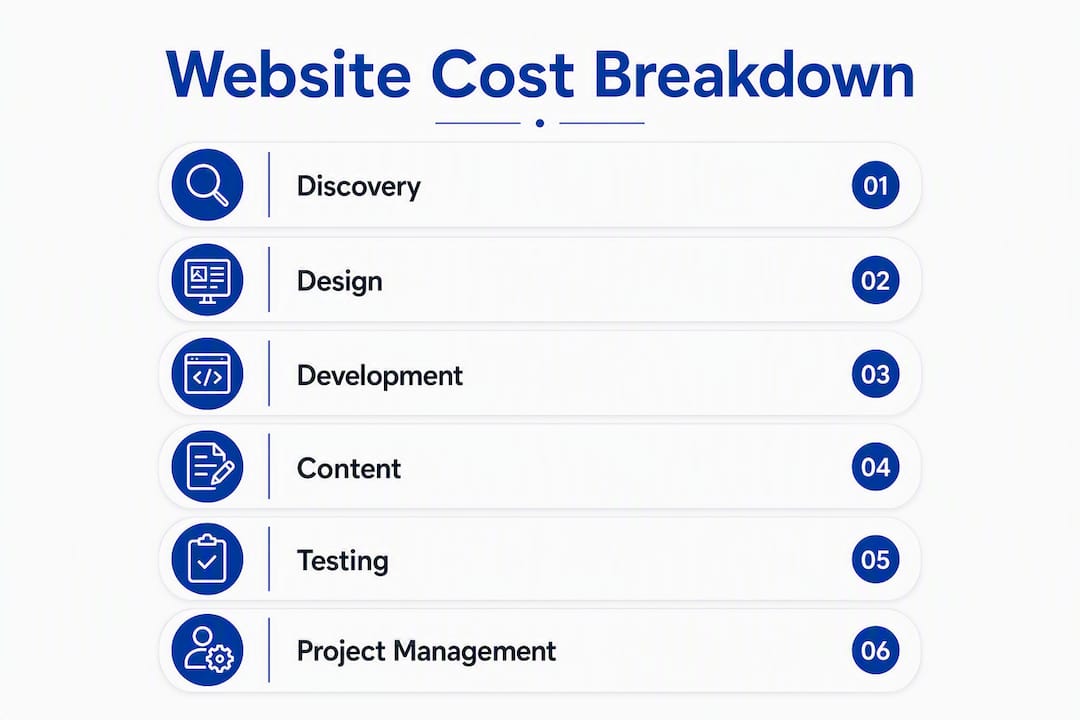
Design includes wireframes, visual design, and the creation of a style guide or component library. A brochure site typically has a moderate cost for design alone; a custom eCommerce design can require significantly more investment.
Development is usually the largest line item. Building out a custom WordPress or Shopify site for a small business costs a moderate to high amount in development hours. Complex integrations, booking systems, or membership areas push this higher.

Content is consistently underbudgeted. Professional copywriting and photography each add appreciable costs, varying by the scope and quality required. Many quotes exclude content entirely, so check.
Testing and launch covers cross-browser QA, performance checks, accessibility testing, and go-live. Budget a moderate amount for testing and launch for a small site, with more for eCommerce.
Project management is often baked into agency rates but worth confirming. On a typical project, project management accounts for a notable portion of total hours.
| Project stage | Small brochure site | Custom SMB site | eCommerce site |
|---|---|---|---|
| Discovery / planning | $500–$1,500 | $1,500–$3,000 | $2,000–$5,000 |
| Design | $1,500–$3,000 | $3,000–$6,000 | $5,000–$12,000 |
| Development | $1,500–$4,000 | $4,000–$10,000 | $8,000–$50,000 |
| Content (copy + images) | $500–$2,000 | $1,500–$4,000 | $2,000–$8,000 |
| Testing / launch | $300–$800 | $500–$1,500 | $1,000–$3,000 |
| Project management | Included | $500–$2,000 | $1,500–$4,000 |
| Estimated total | $4,300–$11,300 | $11,000–$26,500 | $19,500–$57,000 |
Pro Tip: Ask every supplier to quote by stage with fixed-scope deliverables per milestone. Vague line items like “website development” with no page count or feature list are where scope creep starts. A milestone-based payment schedule also protects you if the project stalls.
What each website type costs in Australia
Landing page or single-page site
A single-page site built for a campaign, event, or MVP product typically costs $1,500–$4,000 through a freelancer, or under $500 self-built on a platform like Squarespace. A one-page website suits sole traders, consultants, or businesses testing a new offer before committing to a full build.
- Deliverables: one scrollable page, contact form, basic on-page SEO, mobile-optimised layout.
- Common extras: copywriting, custom photography, Google Analytics setup.
Brochure / small-business site (5–10 pages)
This is the most common entry point for Australian SMBs. WhatstheDamage puts the range at $2,000–$6,000 for most small-business sites, with custom builds reaching $6,000–$15,000.
| Dimension | Brochure site | Custom SMB site |
|---|---|---|
| Setup price range | $2,000–$6,000 | $6,000–$15,000 |
| Ongoing monthly cost | $75–$200 | $150–$400 |
| Best for | Service businesses, tradies, local retailers | Professional services, growing SMBs |
| Timeline to launch | 3–6 weeks | 6–12 weeks |
| Customisation level | Low–medium | Medium–high |
- Deliverables: up to 10 pages, CMS access, contact forms, basic SEO setup, Google Analytics.
- Common hidden extras: blog setup, Google Business Profile integration, booking widgets.
eCommerce site
Simple eCommerce starts around $8,000 and can exceed $50,000 for stores with large catalogues, custom shipping rules, and third-party integrations. Bark’s Australian data confirms this range, noting that payments, shipping configuration, and product data entry are the primary cost drivers beyond the base build.
- Deliverables: product catalogue, payment gateway (Stripe, Afterpay), shipping rules, order management.
- Common hidden extras: inventory sync, loyalty programmes, abandoned cart flows, returns portal.
Enterprise or complex custom build
For multi-location businesses, SaaS platforms, or sites requiring custom APIs and login areas, ConductHQ reports costs from $80,000 to $250,000+. These projects involve dedicated project managers, UX researchers, and senior developers working over months, not weeks.
What you keep paying after launch: ongoing costs
The launch price is the start, not the finish. Ongoing costs for an Australian website typically run $75–$400/month depending on hosting tier, maintenance level, and licences.

| Ongoing item | Low tier | Mid tier | High tier |
|---|---|---|---|
| Hosting (shared to managed) | $15–$30/month | $50–$80/month | $100–$150/month |
| Domain (.com.au) | $15–$30/year | $15–$30/year | $15–$30/year |
| SSL certificate | Often included | Often included | Often included |
| CMS / plugin licences | $50–$100/month | $50–$150/month | $150–$400/month |
| Maintenance / care plan | $50–$100/month | $150–$300/month | $500–$2,000+/month |
Care plans at the mid-to-high tier typically include monthly plugin updates, security monitoring, offsite backups, uptime monitoring, and a set number of content-change hours. Basic plans at $50–$100/month usually cover backups and updates only, with no guaranteed response time.
Key ongoing items to confirm before you sign:
- Backups — daily offsite backups are non-negotiable for any business site.
Pro Tip: Before signing a maintenance agreement, ask three specific questions: What is the guaranteed response time for a site-down emergency? Who holds the hosting login credentials? Are backups stored offsite and tested monthly? The answers reveal whether you are buying real protection or a retainer that just covers routine updates.
What pushes your website quote up or down
Two quotes for “a website” can differ by $10,000 and both be fair. Here is what drives the gap.
Primary cost drivers:
- Page and product count: every additional page or product category adds design, development, and content hours.
- Custom design vs template: a bespoke design from scratch costs 2–3x more than adapting a premium template.
- Bespoke functionality: booking systems, membership areas, calculators, and custom search all require significant development time.
- Integrations: connecting to a CRM (HubSpot, Salesforce), accounting software (Xero, MYOB), or third-party APIs is rarely cheap. Each integration can add $1,000–$5,000 depending on complexity.
- Accessibility and compliance: building to WCAG 2.1 AA standard adds time but reduces legal risk (see Section 8).
- Content creation: copy, photography, and video are often excluded from base quotes. A full content package for a 10-page site can add $3,000–$8,000.
- Timeline urgency: a rushed four-week delivery on a project scoped for 10 weeks typically attracts a 20–30% premium.
ConductHQ notes that platform choice shifts the build cost, but research, information architecture, and content make up the larger share of total cost and long-term value. Choosing WordPress over Squarespace saves less than you think if the IA and copy are weak.
Pro Tip: Prioritise your feature list into three tiers: must-have at launch, nice-to-have in phase two, and future consideration. A phased build lets you launch faster, spend less upfront, and validate what users actually need before committing to expensive functionality.
Agency, freelancer, or DIY: how to choose and what to ask
The right procurement route depends on your budget, timeline, and how central the website is to your revenue.
| Factor | DIY builder | Freelancer / small studio | Agency / custom |
|---|---|---|---|
| Typical cost | $2,000–$10,000 | $2,000–$15,000 | $15,000–$250,000+ |
| Timeline | 1–4 weeks | 4–10 weeks | 8–20+ weeks |
| Quality ceiling | Medium | Medium–high | High |
| Ongoing support | Platform support only | Varies | Usually included |
| Risk | Low cost, high time | Medium | Low if scoped well |
| Best for | Sole traders, MVPs | Established SMBs | Growth-focused businesses |
For Melbourne businesses, metro-based agencies and studios sit at the upper end of national rate bands. WhatstheDamage confirms that Sydney and Melbourne ranges sit at the upper end of national bands, with costs moving roughly 3.4% year-on-year. Checking a Melbourne web design agency’s portfolio for local case studies is worth the time before committing.
Questions to ask every supplier before signing:
- What is included in scope, and what triggers a change order?
- Who owns the domain, hosting account, and CMS login after launch?
- What platform are you building on, and can I move to another provider later?
- How do you handle SEO during the build (URL structure, redirects, metadata)?
- What is the payment schedule, and what are the milestones?
- What does post-launch support look like, and what does it cost?
- Can you provide two or three references from similar-sized Australian businesses?
- What is your process if the project runs over timeline or scope?
Verifying capability means looking beyond the portfolio. Ask for a live URL from a recent project and check its Google PageSpeed score. Ask whether the team that built the portfolio work is the same team that will build yours. For a best web design agency in Australia, local case studies and verifiable client outcomes matter more than award logos.
Pro Tip: Include a post-launch iteration budget in the initial scope, or negotiate a small monthly retainer for the first three months. The first 90 days after launch almost always surface UX issues, copy gaps, and technical fixes that were invisible during development.
Real-world sample budgets: what each spend level actually buys
These four scenarios reflect realistic Australian business situations and the outcomes each budget typically delivers.
| Budget | Business scenario | Timeline | Key deliverables | Expected outcome |
|---|---|---|---|---|
| $3,000 | Suburban tradie (plumber, electrician) | 3–4 weeks | 5-page brochure site, contact form, Google Maps embed, basic on-page SEO | Replaces word-of-mouth dependency; captures local search traffic |
| $7,000 | Solo professional (accountant, consultant) | 5–8 weeks | 8–10 pages, custom design, blog, lead magnet form, Google Analytics 4 setup | Generates qualified enquiries; supports content marketing |
| $15,000 | Growing services firm (marketing, legal, allied health) | 8–12 weeks | Bespoke design, CMS, conversion-optimised landing pages, SEO foundation, photography | Measurable lead pipeline; positions firm above local competitors |
| $40,000 | Multi-location retailer or eCommerce brand | 12–20 weeks | Custom eCommerce, payment gateway, shipping integrations, loyalty programme, analytics dashboard | Online revenue channel; reduces reliance on physical foot traffic |
The $3,000 tradie site and the $40,000 eCommerce build are both legitimate investments, but only when matched to the right business stage. Spending $40,000 on a site before you have validated your product range is as risky as spending $3,000 on a site that needs to convert $500,000 in annual revenue.
Melbourne and Sydney businesses should expect to pay toward the upper end of each band. A $7,000 project in a regional market might cost $9,000–$10,000 with a metro studio.
For ongoing SEO pricing in Australia, budget separately from the build. One-off SEO setup typically runs $1,000–$3,000, with ongoing monthly SEO from $500–$3,000+ depending on competitiveness.
Pro Tip: Track three metrics in the first six months: organic search impressions (Google Search Console), enquiry or conversion rate (Google Analytics 4), and cost per lead. These three numbers tell you whether the site is working and where to invest next.
Legal and compliance costs for Australian websites
Australian websites carry specific legal obligations that add to your build cost if handled properly, or add to your risk if ignored.
Privacy Act compliance is mandatory for most businesses with an annual turnover above $3 million, and for health service providers regardless of size. Your site needs a compliant privacy policy that discloses what data you collect, how it is used, and how users can access or delete it. A lawyer-drafted privacy policy costs $300–$800; a template from a reputable provider runs $50–$200 but carries more risk.
Australian Consumer Law (ACL) requires that your website does not make misleading claims, displays clear pricing (including GST), and provides accurate refund and returns information for any goods or services sold. Building ACL-compliant checkout flows and terms pages adds $500–$2,000 to an eCommerce build.
Accessibility (WCAG 2.1 AA) is not yet a hard legal requirement for private-sector websites in Australia, but it is increasingly referenced in discrimination complaints under the Disability Discrimination Act 1992. Government and education sites must comply. For private businesses, building to WCAG 2.1 AA standard adds roughly 10–20% to development cost but significantly reduces risk and improves SEO.
Spam Act 2003 compliance affects any site with email marketing integration. Your opt-in forms, unsubscribe mechanisms, and email sender identification must meet the Act’s requirements. This is usually handled in the email platform (Mailchimp, Klaviyo) rather than the site build, but the integration needs to be set up correctly.
Cybersecurity is worth budgeting for separately. The Australian Cyber Security Centre recommends multi-factor authentication, regular patching, and secure hosting configurations. A security audit post-launch costs $500–$2,000 for a small business site.
GST and its impact on your website project cost
GST adds 10% to most website design and development services in Australia. A quote of $10,000 plus GST becomes $11,000. This is straightforward, but several nuances catch business owners out.
If your business is registered for GST, you can claim the GST component of website costs as an input tax credit, effectively reducing the real cost by 10%. Always ask suppliers whether their quotes are inclusive or exclusive of GST, and confirm this in writing before signing.
The ATO also allows businesses to deduct website costs as a business expense. Ongoing costs (hosting, maintenance, subscriptions) are generally deductible in the year incurred. Capital costs for building or significantly upgrading a site may need to be depreciated, though the instant asset write-off scheme has historically allowed eligible small businesses to write off assets immediately. Confirm current thresholds and eligibility with your accountant, as these rules change.
One practical note: some overseas platform subscriptions (Squarespace, Shopify, Wix) charge GST on their Australian billing. Others do not. Check your invoices and claim what you are entitled to.
Budgeting for marketing and SEO after your site launches
A website without traffic is a brochure in a locked drawer. The build cost is only part of what it takes to generate leads or sales from a new site.
SEO setup should be budgeted as a separate line item. One-off technical SEO and keyword strategy work typically costs $1,000–$3,000. Ongoing monthly SEO, including content creation, link building, and reporting, runs $500–$3,000+ per month depending on how competitive your industry and location are. For Melbourne-specific SEO costs, metro competition pushes most serious campaigns toward the mid-to-upper end of that range.
Google Ads can generate traffic from day one while organic rankings build. A realistic starting budget for a service business is $1,500–$3,000/month in ad spend, plus management fees. Mybusinessmarketingcoach’s Google Ads management pricing guide covers what each budget tier delivers in practice.
Content marketing compounds over time. A monthly blog or resource programme costs $500–$2,000/month for professionally written content, and it builds organic traffic that paid ads cannot replicate.
Local listings and directories are low-cost but high-impact for local businesses. Claiming and optimising your Google Business Profile is free. Paid Australian business directories add modest annual fees but improve local search visibility.
A realistic post-launch marketing budget for an Australian SMB:
- Months 1–3: $1,500–$3,000/month (SEO setup, Google Ads, content)
- Months 4–12: $2,000–$5,000/month (ongoing SEO, ads, content, email)
- Year 2+: scale based on cost-per-lead data from year one
Tying your website investment to a small business marketing plan from the start means every dollar spent on the build has a clear path to return.
Key takeaways
Most Australian SMBs spend a moderate amount on a professional website build, but the total cost of ownership over several years, including hosting, maintenance, and marketing, is significantly higher.
| Point | Details |
|---|---|
| Core price bands | DIY sites cost $2,000–$10,000; custom SMB sites $15,000–$50,000; eCommerce $10,000–$60,000+. |
| Ongoing costs matter | Budget $75–$400/month for hosting, maintenance, and licences on top of the setup fee. |
| GST and tax treatment | All quotes should state GST separately; GST-registered businesses can claim input tax credits on website costs. |
| Top cost drivers | Page count, custom design, integrations, content creation, and timeline urgency push prices up fastest. |
| Post-launch marketing | Budget $1,500–$3,000/month for SEO and Google Ads in the first three months to generate traffic. |
| Mybusinessmarketingcoach | Offers website design, SEO, and business coaching for Melbourne SMBs who want a strategic build with measurable ROI. |
Why the cheapest website quote usually costs more in the long run
The most common mistake Australian business owners make is treating a website as a one-off purchase rather than a strategic asset. A $2,500 template site built without IA, conversion copy, or SEO foundations will generate almost no organic traffic and convert poorly. You will rebuild it in 18 months.
The research backs this up. ConductHQ’s analysis is direct: platform choice shifts the build cost, but information architecture, content, and research make up the larger share of total cost and long-term value. A well-structured $12,000 site built around your customer’s decision journey will outperform a $4,000 template site every time, not because it looks better, but because it is built to do a job.
What actually moves the needle is not the platform licence or the number of pages. It is the quality of the IA, the clarity of the conversion copy, and whether the site was built with a specific business outcome in mind. Modular, well-documented code also matters more than most business owners realise. A site built on clean, documented foundations can be extended, handed to a new developer, or migrated without starting from scratch. A complex, undocumented custom build locks you in.
Spend on the things that compound: good IA, durable code, professional copy, and a post-launch SEO plan. Cut the things that do not: unnecessary animations, premium platform licences for features you will never use, and rushed timelines that skip QA.
Mybusinessmarketingcoach: website design and marketing for Melbourne SMBs
For Melbourne business owners who want a website that generates leads rather than just existing online, Mybusinessmarketingcoach offers a practical alternative to the generic agency model. The focus is on building sites around measurable business outcomes: enquiries, conversions, and organic search growth, not just a polished design delivered and forgotten.
Projects start with a scoped brief and a clear deliverables list, so you know exactly what you are paying for before work begins. Website design is integrated with SEO services and business coaching so the site is built to support your broader growth strategy from day one. For businesses that need both a new site and a marketing plan to activate it, that integrated approach removes the gap between “we built your site” and “here is how to grow with it.”
Starting budgets vary by scope, with custom builds including SEO foundations generally starting at a moderate investment level. Book a consultation to get a scoped quote and a site audit that shows exactly where your current digital presence is losing leads.
Further reading: useful sources and next steps
Research and pricing references:
Australian government and compliance sources:
- Website costs and tax deductions | ATO
- Cybersecurity guidance for small business | ACSC
Mybusinessmarketingcoach guides:
- SEO pricing Australia: what each budget actually buys
- Best web design agencies in Australia: 2026 guide
- Small business marketing plan: a practical guide for Australia
- Mybusinessmarketingcoach homepage