
A small business marketing plan is a concise, actionable document that links one measurable business outcome to a few focused channels and a set of weekly tasks. Done right, it fits on a few pages and gets reviewed every week, not filed and forgotten. Effective plans share several core components:
- Executive summary — your one-paragraph business snapshot and the single outcome the plan must deliver
- Situational analysis — a SWOT and 3 months of revenue and customer data
- Target customer profiles — 1–2 buyer personas with demographics, triggers, and preferred channels
- SMART objectives and KPIs — 1–3 specific, measurable goals tied to revenue or acquisition
- Channel strategy — 2–3 primary channels matched to your customer profile and capacity
- 90-day action plan — weekly tasks, owners, and metrics for each channel
TL;DR checklist (copy this into your one-page plan):
- [ ] Write one SMART goal (e.g. “a specific number of new clients within a set time frame”)
- [ ] Identify your top 2 customer segments
- [ ] Pick a couple of channels where those customers spend attention
- [ ] Assign weekly tasks and an owner for each channel
- [ ] Set a monthly budget and a target cost per acquisition
- [ ] Schedule a weekly 15-minute scorecard review
Business.gov.au provides an editable marketing plan tool you can download free. Xero also offers a free SMB template that links goals directly to financials. Mybusinessmarketingcoach works with Melbourne business owners to build and run plans like this from day one.
Pro Tip: Keep your plan to 4–6 pages maximum. A plan you read every Monday beats a 40-page document you open once a year.
Table of Contents
- Why does your small business need a marketing plan?
- How to write your small business marketing plan step by step
- How to use the 90-day planner and marketing plan template
- How do you set SMART goals and KPIs for your business?
- Which channels actually move the needle for small businesses?
- What should your marketing budget look like in AUD?
- How do you execute your plan and know when to pivot?
- When should you hire a marketing coach or agency in Australia?
- Key takeaways
- Ready to build your plan? Here’s how Mybusinessmarketingcoach can help
Why does your small business need a marketing plan?
A plan turns marketing from guesswork into predictable, measurable work. Without one, most small businesses spend inconsistently, chase tactics that feel urgent, and have no way to know what’s actually driving revenue. With one, you know exactly which activities to run each week, what each one costs, and whether it’s working.
The metrics that signal a healthy plan are straightforward: new leads per month, conversion rate from lead to sale, revenue per campaign, repeat-customer rate, and customer lifetime value (LTV). These five numbers tell you whether your marketing is growing the business or just keeping it busy.
A marketing plan defines your target market, the messages and channels you’ll use to reach them, your goals and timing, your budget, and how you’ll measure success. That’s the framework Business.gov.au recommends for every Australian small business — and it’s the same framework that separates owners who grow predictably from those who feel like they’re always starting from scratch.
Consider a suburban Melbourne plumber with no plan: spending $800/month on Facebook ads with no tracking, no follow-up email sequence, and no idea of his conversion rate. After building a simple plan, he shifted $400 to Google Search (high purchase intent), added a follow-up SMS sequence, and tracked leads weekly. Within 90 days, his cost per booked job dropped and his monthly revenue from new clients increased. The plan didn’t change his budget. It changed where the money went and how he measured results.
How to write your small business marketing plan step by step
Follow these six steps in order. Each one builds on the last.
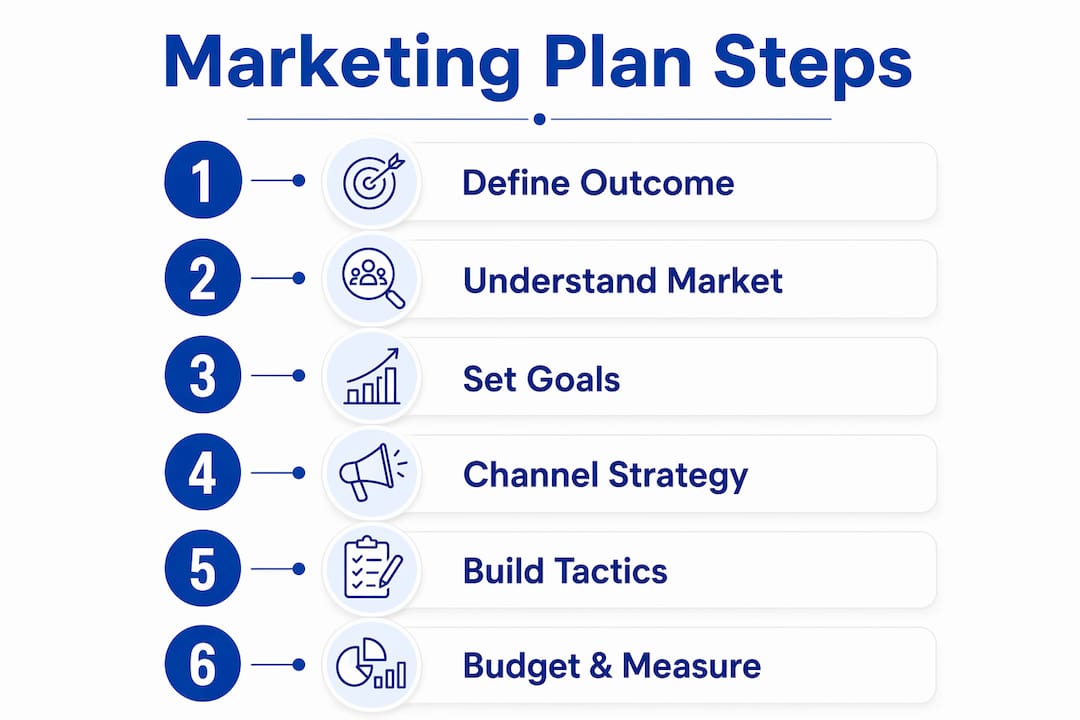
Step 1: Define the one business outcome your plan must deliver
Start with a single measurable outcome: revenue, leads, or bookings. Everything else in the plan serves this number. A SMART objective looks like: “Generate 12 new clients worth $5,000 each ($60,000 revenue) within 90 days through Google Search and referral.”
Step 2: Run your situational analysis and SWOT
Gather 3 months of revenue data, identify your top-selling products or services, and map your customer segments. Then complete a SWOT tailored to your Australian market context:
- Strengths: What do you do better than local competitors? (Speed, price, specialisation, relationships)
- Weaknesses: Where do customers drop off? (Slow response times, weak online presence, limited reviews)
- Opportunities: Local demand gaps, seasonal peaks, underserved suburbs or postcodes
- Threats: New competitors, rising ad costs, platform algorithm changes
Step 3: Build 1–2 target customer profiles
A buyer profile needs demographics (age, location, income), buying triggers (what prompts them to search), preferred channels (Google, Instagram, word of mouth), and common objections (price, trust, timing). Use these three interview prompts with your best existing customers:
- “What made you look for a business like ours?”
- “Where did you find us, and what made you choose us over others?”
- “What almost stopped you from buying?”
Step 4: Choose your channel strategy
Pick 2–3 channels that match your customer profile and your weekly capacity. A sole trader running a service business in Melbourne’s inner suburbs will get faster results from Google Business Profile optimisation and email follow-up than from a broad social media presence. Match the channel to the customer’s buying behaviour, not to what feels easiest to post.

Step 5: Build your tactics and 90-day timeline
Break each channel into weekly tasks. Assign an owner (even if that’s you) and a specific metric. Week 1 of Google Search might be: set up conversion tracking, write 3 ad groups, set a daily budget cap. Week 2: review search terms report, pause irrelevant keywords, test one new headline.
Step 6: Set your budget and measurement cadence
Tie each tactic to an expected KPI and a cost. Use Xero’s template to link spend to expected leads and revenue. Set a monthly review date and commit to it.

Government guidance confirms that target market, channel selection, and budget are mandatory inclusions in any credible marketing plan. Skip one and the plan loses its ability to guide decisions.
How to use the 90-day planner and marketing plan template
The most practical template structure for an Australian small business has three parts: a one-page executive summary, a 90-day planner, and a KPI scorecard. StartupOwl’s template packages these as fillable Word or Google Docs files, which makes weekly updates fast.
To populate the 90-day planner, take each tactic from your channel strategy and assign it a week, an owner, and a metric. Here’s how that looks for a suburban café in Melbourne’s eastern suburbs running three channels: local SEO, an email newsletter, and a weekend promotion.
| Week | Activity | Owner | KPI |
|---|---|---|---|
| Week 1 | Optimise Google Business Profile (photos, hours, posts) | Owner | Profile views +20% |
| Week 2 | Send first email newsletter (offer + story) | Owner | Open rate >25% |
| Week 3 | Run weekend promotion (social post + in-store signage) | Staff | Weekend covers vs. prior week |
| Week 4 | Review all three metrics, adjust Week 5 tasks | Owner | Scorecard completed |
| Week 5–12 | Repeat cycle with one tweak per channel per fortnight | Owner | Leads and bookings trend |
The key discipline is the Week 4 review. Most small business owners skip it. That review is where the plan stays alive.
- Download the template, fill in your executive summary first (one paragraph, one goal, two channels)
- Populate weeks 1–4 before you start, then plan weeks 5–12 loosely
- Keep the KPI scorecard on your desk or pinned in your project management tool
How do you set SMART goals and KPIs for your business?
A SMART marketing objective for an Australian small business is specific, measurable, achievable, relevant, and time-bound. The most common mistake is writing a goal like “get more customers.” That tells you nothing about whether you’re winning.
A strong SMART objective: “Add 12 new clients worth $60,000 in revenue within 90 days by converting Google Search leads at a 20% rate.”
From that one objective, you can derive every KPI you need.
| KPI | Definition | How to measure | Cadence |
|---|---|---|---|
| Cost per acquisition (CPA) | Total spend ÷ new clients | Ad platform + CRM | Weekly |
| Conversion rate | Leads ÷ sales | CRM or spreadsheet | Weekly |
| Customer lifetime value (LTV) | Avg. order value × repeat purchases | Accounting software | Monthly |
| Average order value (AOV) | Total revenue ÷ number of orders | POS or invoicing tool | Monthly |
| Repeat customer rate | Returning customers ÷ total customers | CRM | Monthly |
KPI prompts to answer each week:
- How many leads did we generate this week, and from which channel?
- What was our conversion rate from lead to sale?
- Did our CPA stay below our target?
- Which channel drove the highest-quality leads?
Xero’s SMB template links these KPIs directly to your financial reporting, which makes the monthly review faster and more useful.
KPI benchmarks vary by business type. A retail business tracks AOV and repeat rate most closely. A trades business watches CPA and booking rate. A professional services firm monitors LTV and referral rate. Hospitality businesses live and die by covers per service and average spend per head. Pick the two KPIs most directly connected to your SMART objective and report on them every week without exception.
Which channels actually move the needle for small businesses?
Prioritise channels where your customers spend attention and where you can measure conversion reliably. That’s the whole framework. Everything else is detail.
Use this scoring approach to evaluate each channel before committing:
| Channel | Best for | Speed to results | Measurement ease |
|---|---|---|---|
| Google Search (paid) | Trades, services, high-intent buyers | Fast (days) | High |
| Google Business Profile / local SEO | All local businesses | Medium (weeks) | Medium |
| Email marketing | Retail, hospitality, repeat-purchase businesses | Fast (days) | High |
| Meta Ads (Facebook/Instagram) | Retail, events, awareness | Medium (weeks) | Medium |
| Referral programme | Professional services, trades | Slow (months) | Low |
| Content/SEO | All, long-term | Slow (months) | Medium |
For a Melbourne retail business: Google Business Profile plus email marketing is a strong starting pair. For a trades business in regional Victoria: Google Search plus a referral programme. For a professional services firm: LinkedIn content plus email nurture.
The 30–90 day test rule: commit a fixed budget to each channel for at least 30 days before judging it. Less than 30 days gives you noise, not signal. If a channel hasn’t hit 50% of its CPA target by day 60, reallocate that budget to the channel that is performing. For practical guidance on SME digital marketing tactics and how to evaluate channels for lead generation, that resource covers the evaluation framework in detail.
Pro Tip: Local SEO is often the highest-ROI channel for Australian service businesses. Optimising your Google Business Profile costs nothing but time and can drive consistent inbound leads within weeks. Start there before spending on paid ads.
For a deeper look at local SEO for your business, Mybusinessmarketingcoach covers the full implementation process.
What should your marketing budget look like in AUD?
Budget by outcome, not by percentage of revenue. Calculate your LTV, set a target CPA, and work backwards to determine how much you can spend per lead and per channel. Xero recommends this approach specifically because it avoids arbitrary rules and keeps spend tied to profitable customer acquisition.
How to calculate your CPA target:
- LTV = average order value × average number of purchases per year × average customer lifespan in years
- Target CPA = LTV × an acceptable acquisition cost ratio appropriate for your business
- If your LTV is $3,000 and you’re willing to spend 20% to acquire a customer, your CPA target is $600
Sample budget shapes for Australian small businesses:
- Early stage (under $500/month): Focus on Google Business Profile (free), one email marketing tool ($20–$50/month via Mailchimp or similar), and organic social. Reserve $300–$400 for one paid channel test.
- Growth stage ($500–$2,000/month): Split between Google Search ($600–$800), email marketing ($50–$100), and local SEO support ($300–$500). Track CPA weekly.
- Scale stage ($2,000–$5,000/month): Add Meta Ads ($500–$1,000), increase Google Search budget, invest in content or SEO ($500–$1,000/month). Reallocate monthly based on CPA performance.
For detailed guidance on setting your marketing budget, Mybusinessmarketingcoach has a dedicated resource that walks through the calculation step by step.
Pro Tip: At the end of every month, move 20% of spend from your lowest-performing channel to your highest-performing one. Small reallocations compound quickly over a 90-day cycle.
How do you execute your plan and know when to pivot?
High-performing small business owners treat their marketing plan as a weekly compass, not an annual document. The weekly ritual takes a short time: review your one-page scorecard, check relevant channel metrics, and decide one tweak for the coming week.
Sample weekly scorecard for an Australian small business:
| Metric | This week | Last week | Target | Action |
|---|---|---|---|---|
| New leads | — | 6 | — | Increase Google Search budget by $50 |
| Conversion rate | 25% | — | 25% | On track — no change |
| CPA | — | — | $500 | Below target — maintain |
| Email open rate | — | — | 30% | Test new subject line next send |
Pivot rules:
- Test every channel for a minimum of 30 days before making a go/no-go decision
- If CPA exceeds your target by more than 50% at day 30, pause and reallocate
- If a channel hits CPA target consistently for 60 days, increase its budget by 25%
- Never pause a channel mid-test without a replacement plan for that spend
Weekly meeting checklist:
- Who owns the review? (Name one person, even if it’s just you)
- What evidence do you need? (Scorecard completed, ad platform data pulled)
- What’s the one next action? (One tweak, not five)
Keep your plan current: when and how to update it
Run three review cadences: weekly task reviews, monthly KPI and budget reallocations, and a quarterly strategy refresh. The quarterly refresh is your 90-day planning cycle reset.
Update triggers that should prompt an out-of-cycle review:
- A channel’s CPA doubles over two consecutive weeks
- A new competitor enters your primary market
- You launch a new product or service
- A platform changes its algorithm or ad pricing significantly
- You hit your SMART objective ahead of schedule
Assign ownership clearly: the business owner runs the weekly and monthly reviews. The quarterly strategy refresh benefits from an external perspective, whether that’s a business coach, a trusted adviser, or a marketing consultant. That outside view catches blind spots the owner is too close to see.
When should you hire a marketing coach or agency in Australia?
Hire external help when one of three conditions is true: you don’t have the time to run the weekly cadence yourself, you lack the specific skill a channel requires (Google Ads, SEO, email automation), or your revenue targets require a scale you can’t staff internally.
Engagement types and what each delivers:
- Marketing coaching — skill transfer over 30–90 days. You learn to run the plan yourself. Best for owners who want capability, not dependency.
- Project work — a defined scope (website build, SEO audit, ad account setup) with a fixed deliverable. Best when you need a specific asset built properly.
- Ongoing managed services — the agency runs your channels month to month. Best when your time is better spent on the business than in it.
Questions to ask any prospective provider:
- Can you show me a case study from a business similar to mine in Australia?
- What KPIs will you report on, and how often?
- What does the first 30 days look like, and what will I need to provide?
- What’s your process when a channel underperforms?
- Do you lock clients into long-term contracts?
Red flags: vague reporting, no clear KPIs in the proposal, guaranteed rankings promises, and pressure to commit to 12-month contracts before seeing results.
Pricing ranges for Australian small businesses vary depending on the engagement type:
| Engagement type | What to expect |
|---|---|
| One-off coaching session | Clarity on one specific problem |
| 90-day coaching programme | Plan built, skills transferred, weekly accountability |
| Project work (website/SEO) | Defined deliverable, fixed scope |
| Ongoing managed services | Channel management, reporting, optimisation |
Mybusinessmarketingcoach offers one-on-one coaching and marketing coaching programmes for Melbourne business owners. In the first 30–60–90 days, a client can expect a completed marketing plan, a 90-day action calendar, and a working KPI scorecard. By day 90, most clients have clearer channel focus, measurable lead flow, and a weekly rhythm they can sustain independently. For guidance on how to choose a business coach in Australia, Mybusinessmarketingcoach has a dedicated checklist.
Key takeaways
A practical small business marketing plan works because it links one measurable outcome to 2–3 focused channels, weekly tasks, and a simple scorecard reviewed every Monday.
| Point | Details |
|---|---|
| Six core components | Every plan needs an executive summary, SWOT, buyer profiles, SMART goals, channel strategy, and a 90-day action plan. |
| Keep it to 4–6 pages | A short plan gets reviewed weekly; a long one gets filed and ignored. |
| Budget by outcome | Calculate LTV and target CPA first, then work backwards to set channel spend. |
| Weekly scorecard habit | Check three channel metrics every week and make one adjustment — that discipline drives consistent growth. |
| Mybusinessmarketingcoach | Offers coaching and managed marketing services in Melbourne to help owners build and run this plan from day one. |
Why lean, weekly-driven plans beat large annual strategies
Most business owners who come to Mybusinessmarketingcoach have already written a marketing plan. It’s usually 20–30 pages, built in a burst of enthusiasm at the start of the financial year, and untouched since. The problem isn’t effort. It’s architecture.
A large annual plan is built around prediction. It assumes you know in January what will work in October. You don’t. Markets shift, channels change, and what your customers respond to in March is different from what worked in July. A lean, 90-day plan built around weekly measurement doesn’t pretend to predict the future. It creates a structure for learning quickly and adjusting before you’ve wasted significant budget.
The Smart Insights approach of a three-page plan built around Opportunity, Strategy, and Action is exactly right for small businesses. Not because brevity is a virtue in itself, but because a short plan forces you to prioritise. If you can’t fit your strategy on three pages, you haven’t made the hard choices yet.
The weekly scorecard is where the real work happens. Owners who regularly review their numbers, make small adjustments, and repeat this process consistently outperform those who run campaigns and check results only occasionally. The cadence matters more than the sophistication of the plan.
One compliance note: when running campaigns in Australia, follow the Australian Consumer Law advertising standards and the Privacy Act 1988 requirements for collecting and using customer data. This article is general guidance, not legal advice. Confirm current rules with a qualified professional for your specific situation.
Ready to build your plan? Here’s how Mybusinessmarketingcoach can help
Building a marketing plan from scratch takes time most business owners don’t have. Mybusinessmarketingcoach works with Melbourne small business owners to do the heavy lifting: building the plan, setting up the KPI scorecard, and running the channels so you can focus on delivering for your clients.
The engagement starts with a discovery call to understand your business outcome, your current channels, and where the gaps are. From there, you get a 30-day roadmap with clear priorities, a scoped proposal for coaching or implementation, and a first 90-day action calendar you can start using immediately. Whether you need SEO services to build your local search presence, a business coaching programme to sharpen your strategy, or full marketing coaching to run the whole plan, there’s an engagement type that fits your stage and budget. Book a discovery call with Mybusinessmarketingcoach to get your 90-day marketing plan started.
Useful Australian sources and templates
| Resource | What it offers | Best used for |
|---|---|---|
| Business.gov.au marketing plan tool | Free editable template with government-backed structure | Starting point for any Australian small business |
| Xero SMB marketing plan template | Links marketing goals to financial tracking | Owners who want KPIs tied to accounting data |
| Smart Insights 3-page template | Lean Opportunity/Strategy/Action format with RACE framework | Businesses wanting a short, focused plan |
| StartupOwl template | 90-day calendar, budget planner, KPI dashboard in Word/Google Docs | Founders who want a ready-to-fill document |
| SA Government marketing plan guide | State-level guidance for South Australian businesses | SA-based businesses wanting local context |
| SME digital marketing tactics | Channel testing methodology and creative ideas for small businesses | Owners evaluating digital channel options |
The downloadable template referenced throughout this guide is the fastest way to get started. If you want coaching support to complete it, Mybusinessmarketingcoach offers a first-session plan review for Melbourne business owners.