
Most Australian businesses should budget an amount within a typical mid-range band per month for agency SEO that genuinely moves the needle. Industry sampling shows about 60% of Australian SMEs fall within this band, reflecting common spending patterns. Below $1,000 a month, the scope is usually too thin to produce measurable business results. Above $5,000, you are typically funding competitive national campaigns or multi-location authority building.
Before you request a quote, ask three questions to make comparisons fair: What specific deliverables are included each month? How is progress reported and how often? What is the minimum contract term and the exit process? Those three questions will separate a real proposal from a vague pitch faster than any price comparison.
Table of Contents
- What does SEO pricing in Australia actually look like by tier?
- How do Australian SEO providers charge, and which model suits you?
- What factors push your SEO quote up or down in Australia?
- What do you actually get for different budget levels?
- How long does SEO take in Australia, and what results should you expect?
- How do you choose the right SEO agency or freelancer in Australia?
- How AI and 2026 search changes affect SEO scope and what you should pay for
- How these price ranges were derived
- How does Australian SEO pricing compare to global benchmarks?
- Does bundling SEO with other digital marketing services change the cost?
- Agency vs freelancer: what the price difference actually means for your business
- Key takeaways
- Where most Australian SMBs should actually spend first
- Mybusinessmarketingcoach: get a scoped SEO quote for your business
- Useful sources and further reading
What does SEO pricing in Australia actually look like by tier?
Australian SEO retainers broadly fall into three tiers. Each one funds a different scope of work, and the gap between them is not just volume — it is the type of work that gets done.
| Tier | Monthly range (AUD) | Typical deliverables | Monthly outputs | Best for |
|---|---|---|---|---|
| Entry | $1,000–$1,500 | Basic technical review, 1–2 content pieces, local listing management, monthly rank report | 1–2 pages, 5–10 keyword targets, GMB updates | Local sole traders, single-location service businesses |
| Growth | $1,500–$5,000 | Technical SEO, 3–6 content pieces, link outreach, Google Business Profile, fortnightly reporting | 3–6 pages, 20 keyword targets, 2–5 link prospects | SMEs, multi-service businesses, regional e-commerce |
| Authority | $5,000–$15,000+ | Full technical programme, 8–15 content pieces, digital PR, structured data, weekly reporting | 8–15 pages, 30–60 keyword targets, 10–20 link placements | National brands, competitive verticals, enterprise e-commerce |
Entry tier ($1,000–$1,500/month)
At this level, expect a basic technical health check at the start, one or two short content pieces per month, and management of your Google Business Profile. Rank tracking and a monthly PDF report are standard. What you will not get: proactive link building, content strategy, conversion rate work, or any meaningful technical remediation beyond quick fixes. Many providers at this price point are reselling white-label work, so ask directly who does the actual work.
Growth tier ($1,500–$5,000/month)
This is where most Australian SMEs should start if they want results within 12 months. The scope expands to regular content production, active link outreach, and fortnightly reporting with traffic and conversion data. Technical SEO moves from reactive to proactive. A good growth-tier retainer should include a documented content calendar, a link-building log, and a clear KPI dashboard.

Authority tier ($5,000–$15,000+/month)
Competitive industries — legal, finance, health, real estate, national retail — typically require this level of investment. The scope includes digital PR, structured data implementation, content clusters built around topical authority, and weekly reporting with conversion attribution. At this tier, the provider should function as a strategic partner, not just a task executor.
Common low-cost traps to watch for:
- No link building included (often described as “on-page only”)
- Content produced by AI with no editorial review or subject-matter input
- Reporting limited to rank position only, with no traffic or conversion data
- No technical audit at onboarding — work starts without a baseline
- Month-to-month scope that quietly shrinks after the first few months
How do Australian SEO providers charge, and which model suits you?
Understanding the payment model matters as much as the price. Four models dominate the Australian market, and each suits a different situation.
Hourly rate
Australian SEO professionals quote hourly rates that vary by role, typically lower for freelancers, moderate for small agencies, and higher for senior consultants. Hourly billing suits small, well-defined tasks: a site speed audit, a keyword mapping session, or a one-off penalty review. The risk is scope creep — hours accumulate quickly on technical work, and without a cap you can overspend on a task that should have been quoted as a fixed project.
Monthly retainer
The most common model for ongoing SEO. You pay a fixed monthly fee for an agreed scope of work. Retainers suit businesses that want consistent output and a long-term growth trajectory. The key discipline is making sure the scope is written down. A retainer with vague deliverables (“ongoing SEO work”) is not a retainer — it is a blank cheque.
Fixed project
Technical audits, site migrations, and penalty recoveries are typically quoted as fixed projects. Project costs for audits and migrations commonly vary depending on site size and complexity, with a wide range reported across providers. Fixed projects give you cost certainty and a clear deliverable, but they do not include ongoing optimisation. Many businesses use a project to establish a baseline, then move to a retainer for the growth phase.
Performance-based
Some providers tie fees to ranking positions or traffic milestones. This sounds attractive, but the model has structural problems. Providers optimise for the metric they are paid on, which can mean chasing easy rankings rather than commercially valuable ones. It also creates disputes when results are delayed by algorithm updates or seasonal factors outside anyone’s control. Use performance components as a bonus structure on top of a base retainer, not as the primary fee model.
Pro Tip: Before signing any retainer, ask for the deliverables list in writing and confirm what happens if a deliverable is missed in a given month. Contracts that define scope only in broad terms (“SEO services”) give the provider no accountability and you no recourse.
What factors push your SEO quote up or down in Australia?
Two businesses in the same city can receive quotes that differ by $3,000 a month for what looks like the same service. These are the variables that actually drive that gap.
Industry competition. A plumber in a regional town and a personal injury lawyer in Sydney are both doing local SEO, but the lawyer’s competitors have spent years and hundreds of thousands of dollars building authority. The more competitive the keyword space, the more content, links, and time are required to compete.
Website size and complexity. A 20-page service site and a 10,000-product e-commerce store need fundamentally different technical programmes. Crawl budget management, faceted navigation, canonical structures, and product schema are all scope items that do not exist on a brochure site.
Technical debt. Sites with years of accumulated issues — duplicate content, broken internal links, slow load times, poor mobile experience — require a remediation phase before growth work can begin. That phase costs money and time. A provider who skips the audit and jumps straight to content is not saving you money; they are building on a cracked foundation.
Content volume and quality needs. Thin content or no existing content means the provider must build from scratch. Industries that require expert authorship (health, finance, legal) cost more because the content cannot be produced by a generalist writer.
Link profile needs. A site with no backlinks in a competitive niche needs active link acquisition from day one. Digital PR and link outreach are labour-intensive and add meaningfully to monthly cost.
Local vs national targeting. Local SEO for a single suburb is cheaper than a national campaign targeting multiple cities. Multi-location businesses often pay per location for citation management and local content.
Pro Tip: If your budget is tight, ask the provider to phase the work. Start with a fixed-price technical audit and the highest-priority fixes, then move to a content-focused retainer once the technical foundation is solid. This approach reduces early spend and gives you a clear baseline to measure from. You can read more about setting a realistic marketing budget before committing to a retainer.
Geographic pricing differences within Australia
Sydney and Melbourne agencies typically charge more than regional providers for comparable scope, reflecting higher operating costs and stronger demand. Regional providers may offer lower pricing for similar scopes. The gap is not always a quality signal — some regional agencies do excellent work. Evaluate on deliverables and references, not postcode.

What do you actually get for different budget levels?
Mapping deliverables to price bands gives you a practical way to evaluate any proposal. If a quote at $1,200 per month promises deliverables that typically require $3,500 in labour, ask how.
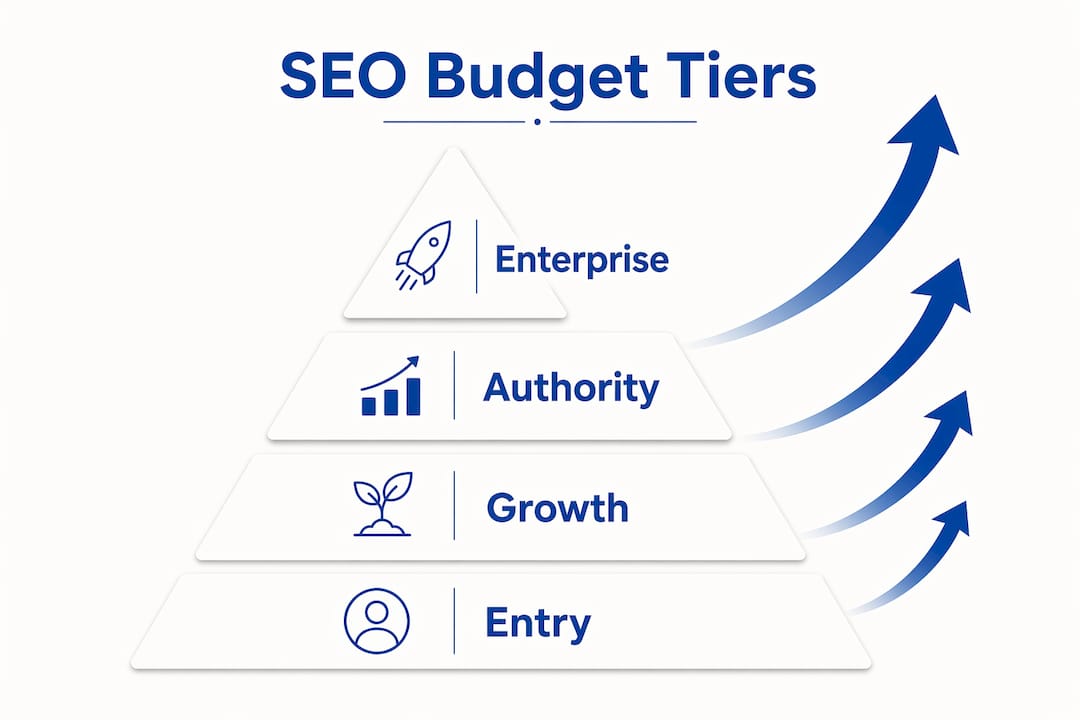
| Budget (AUD/month) | Technical SEO | Content | Link building | Local/GMB | Reporting |
|---|---|---|---|---|---|
| Under $1,500 | Initial audit, minor fixes | 1–2 short articles | None or minimal | Basic GMB updates | Monthly rank report |
| $1,500–$3,000 | Ongoing technical monitoring, priority fixes | 3–4 articles or landing pages | 2–4 link prospects | GMB posts, citation audit | Fortnightly traffic + rank report |
| $3,000–$7,000 | Full technical programme, Core Web Vitals, schema | 5–8 pieces including pillar content | 5–10 link placements, digital PR | Multi-location management | Weekly dashboard, conversion tracking |
| $7,000+ | Enterprise technical, crawl management, international | 10–20 pieces, content clusters | 15+ placements, PR campaigns | Full local authority programme | Custom reporting, attribution modelling |
KPIs to expect at each tier:
- Under $1,500: keyword rank positions for 10–20 target terms, Google Business Profile views
- $1,500–$3,000: organic traffic (sessions and users), rank tracking for 30–60 terms, lead form submissions
- $3,000–$7,000: organic traffic, conversion rate by landing page, domain authority trend, backlink growth, Core Web Vitals scores
- $7,000+: revenue attribution, share of voice, content engagement metrics, crawl health trends
Deliverables often missing from low-cost packages:
- Content strategy and keyword mapping (not just writing)
- Conversion rate optimisation on organic landing pages
- CMS-level technical work (redirects, canonical tags, schema implementation)
- Disavow file management for sites with toxic link profiles
- Competitor gap analysis updated quarterly
How long does SEO take in Australia, and what results should you expect?
SEO timelines in Australia follow a broadly predictable pattern, though competitive niches and site history can compress or extend each phase.
Months 1–3 (technical and quick wins). The first phase is mostly invisible to the outside world. Technical fixes are implemented, Google Search Console is configured, priority pages are optimised, and local listings are cleaned up. You might see early movement on low-competition keywords and a reduction in crawl errors. Do not expect significant traffic growth yet.
Months 4–6 (content and early ranking gains). Content published in months 1–3 starts to index and rank. If link outreach has begun, early placements start to build domain authority. Local businesses often see their first meaningful lead increases in this window, particularly if Google Business Profile work was strong.
Months 7–12 (compounding growth). This is where the investment starts to show a return. Content clusters build topical authority, links accumulate, and rankings for competitive terms begin to move. A well-run growth-tier campaign for a local service business should show a clear organic traffic increase and measurable lead growth by month 9–12.
Realistic benchmark: A local service business investing at the growth tier ($1,500–$3,000/month) can reasonably expect a 30–60% increase in organic traffic within 12 months, assuming consistent content output and active link building. National e-commerce campaigns at the authority tier typically require 12–18 months before ROI becomes clearly positive. Competitive verticals like legal, finance, and health often take longer still.
Variability factors. A site migration, a Google algorithm update, or a highly seasonal business can all shift these timelines. Providers who guarantee specific outcomes within fixed timeframes are either working in very low-competition niches or overpromising. For a deeper look at what is working in search right now, the SEO in 2025 and 2026 overview covers the current landscape in practical terms.
How do you choose the right SEO agency or freelancer in Australia?
A structured evaluation process protects your budget and filters out providers who cannot deliver. Use this framework when you are comparing proposals.
Scoring criteria (suggested weighting):
- Deliverables clarity and specificity: 30%
- Reporting transparency and KPI definition: 20%
- Relevant industry or niche experience: 20%
- Pricing clarity and contract terms: 15%
- References and case study quality: 15%
15 questions to ask when getting SEO quotes
- What specific deliverables will I receive each month, listed by item?
- Who on your team will do the work — in-house or outsourced?
- What tools do you use for rank tracking, technical audits, and reporting?
- How do you define success for a campaign like mine, and what KPIs will you report on?
- Can you show me a sample monthly report from a current client?
- What does your onboarding process look like in the first 30 days?
- How do you approach keyword research and content strategy?
- What is your link-building methodology, and can you show me examples of placements you have secured?
- Do you produce content in-house, and who are the writers?
- How do you handle technical SEO — do you implement changes directly or provide recommendations only?
- What happens if a deliverable is not completed in a given month?
- What is the minimum contract term, and what are the exit conditions?
- Have you worked in my industry or with businesses at my revenue level?
- Can you provide two or three client references I can contact directly?
- How are you adapting your approach for AI-driven search in 2026?
Red flags to watch for:
- Guaranteed first-page rankings (no ethical provider can guarantee this)
- Vague scope (“we do everything SEO”) with no itemised deliverables
- No reporting or reporting limited to rank positions only
- Link-building described as “high DA links” with no mention of relevance or editorial standards
- Pressure to sign quickly or claims that prices are about to increase
- No case studies or references from real clients
- A single-person operation being proposed for an enterprise-scale campaign
Comparing proposals side by side. Convert every proposal to a common unit: deliverables per dollar. If Agency A quotes $3,000 for four content pieces and eight link prospects, and Agency B quotes $2,500 for two content pieces and no link building, they are not comparable at face value. Normalise scope before you compare price.
How AI and 2026 search changes affect SEO scope and what you should pay for
The shift to AI-augmented search is no longer a future concern for Australian businesses — it is already changing what effective SEO requires. Google’s AI Overviews, generative answer features, and the growing role of large language models in how people discover businesses have all expanded the scope of work that a credible SEO programme must cover.
AI-driven search changes mean providers must now invest more in topical depth, structured data, entity signals, and content that is genuinely useful to both human readers and AI summarisation systems. A page that ranks because it has the right keyword density is far less durable than a page that ranks because it is the most authoritative answer on a topic.
The 2026 reality: Generative AI summaries are pulling answers directly from well-structured, authoritative content. If your content is thin, generic, or poorly marked up with schema, it will not appear in AI-generated answers — regardless of where it ranks in traditional results. Buyers should ask every provider how they are optimising for generative discoverability, not just traditional rank positions.
Practical scope changes you should see in 2026 retainers:
- Content strategy built around topical clusters, not just individual keywords
- Schema markup implementation for products, services, FAQs, and local business data
- Structured data audits as a standing monthly item
- Content experimentation with outcome-based reporting (not just traffic, but engagement and conversion)
- Entity optimisation — making sure your business, people, and products are clearly understood by search systems
- Regular reporting on AI Overview appearances and featured snippet capture
How these changes affect pricing. Higher-skill content, more technical schema work, and the need for genuine subject-matter expertise all push costs upward. Providers who are not yet including these elements in their retainers are either behind the curve or working at a price point that cannot fund the labour. When you are evaluating quotes, ask specifically what the provider does to optimise for AI-augmented search. If the answer is vague, that is a signal. You can explore the 2026 SEO trends and tactics in more detail to benchmark what good looks like.
How these price ranges were derived
The ranges in this guide are based on market sampling of Australian SEO providers, published industry pricing guides, and supplier price listings across major Australian cities and regional markets. They represent the scope of work a business should expect at each price point — not the cheapest available option or the most expensive.
| Data source | What it covers | How it was used |
|---|---|---|
| Industry pricing guides (Australian market) | Published retainer and project ranges from multiple providers | Median range calculation for each tier |
| Supplier price listings | Itemised scope from agency websites and proposal templates | Deliverable mapping by price band |
| Market commentary and surveys | SME budget behaviour and spend patterns | Validation of the 60% SME band figure |
| Geographic sampling | Sydney, Melbourne, Brisbane, Perth, regional Australia | City vs regional price adjustment |
Core assumptions. “Effective SEO” in this guide means work that includes at minimum: a technical audit at onboarding, ongoing technical monitoring, content production, some form of link activity, and regular reporting with traffic and conversion data. Packages that exclude any of these elements are not comparable to the ranges stated here.
Exclusions. Paid search (Google Ads), social media advertising, and website redesign costs are not included in these ranges. Integrated digital marketing packages that bundle these services will cost more.
Caveat. These ranges are budgeting anchors, not fixed quotes. Your actual cost will depend on your site’s current state, your industry, and your growth targets. Get at least three scoped proposals before committing, and normalise scope before comparing prices.
How does Australian SEO pricing compare to global benchmarks?
Australian SEO retainers sit above the global average, reflecting higher labour costs, a smaller talent pool relative to demand, and the cost of operating in major Australian cities. US-based agencies often quote monthly retainers in the USD $1,000–$3,000 range for comparable scope — which at current exchange rates is broadly similar to the lower end of the Australian growth tier, but the deliverable depth often differs.
UK agencies tend to price similarly to Australia at the mid-tier, though London-based providers can exceed Australian authority-tier rates for competitive verticals. South-East Asian providers frequently quote well below Australian rates, but the quality of content, link placements, and strategic thinking varies significantly. Offshoring parts of the work (content production, technical implementation) is common among Australian agencies, and it is worth asking any provider what proportion of the work is done locally versus offshore.
The more useful comparison for Australian buyers is not global pricing but local value: what does $2,500 per month actually buy from an Australian provider with demonstrable local market knowledge, versus a cheaper offshore option with no understanding of Australian search behaviour, local citation sources, or industry-specific compliance requirements?
Does bundling SEO with other digital marketing services change the cost?
Bundling SEO with Google Ads, Meta Ads, or website management can reduce the per-service cost, but it changes the accountability structure. When one provider manages multiple channels, it is easier to attribute results correctly — organic traffic growth is not confused with paid traffic, and the team can coordinate messaging across channels. That coordination has real value.
The cost impact works in both directions. A provider managing your SEO, Google Ads, and website will often discount the combined retainer compared to three separate providers. But if SEO performance is poor, it can be harder to isolate the cause when multiple services are intertwined. Integrated retainers also tend to have longer minimum contract terms.
For most Australian SMEs, a practical approach is to start with SEO as the primary channel, then add paid search once organic traffic is generating a baseline of leads. This sequences the spend logically and avoids paying for paid traffic to pages that are not yet optimised to convert. Mybusinessmarketingcoach offers integrated digital marketing services — including SEO, Google Ads, and website design — for Melbourne business owners who want a coordinated approach without managing multiple providers.
Agency vs freelancer: what the price difference actually means for your business
Freelancers typically charge less than agencies for the same nominal scope, but the comparison is rarely apples-to-apples. A senior freelance SEO consultant at AUD $150–$200 per hour brings deep expertise but limited bandwidth. They can handle strategy, technical work, and content direction, but they usually cannot produce high-volume content, run link outreach campaigns, and manage reporting simultaneously without either cutting corners or bringing in subcontractors.
Agencies charge more because they are funding a team: an account manager, a technical SEO specialist, a content writer, a link builder, and a reporting function. At the growth tier, that team structure is what makes consistent monthly output possible. The risk with agencies is that junior staff do the execution while senior staff do the pitching — ask specifically who will work on your account day-to-day.
A single in-house SEO hire, when you factor in salary, superannuation, tools, and training, often costs as much as a mid-tier agency retainer on a monthly basis — without the breadth of skills a team provides. For most SMEs, an agency or senior freelancer is more cost-effective than a full-time hire until the business reaches a scale where in-house makes sense.
The hybrid model. Many Australian businesses get the best outcome by combining a freelancer or coach for strategy with an agency or in-house team for execution. This keeps strategic thinking senior and execution costs manageable. If you want to handle parts of your SEO in-house, the DIY SEO toolkit for business owners is a practical starting point for building internal capability.
Key takeaways
Effective SEO in Australia costs more than most low-cost packages promise — the growth tier ($1,500–$5,000/month) is where most SMEs find the scope that actually produces results, and the 15-question checklist above is your fastest filter for separating real proposals from vague ones.
| Point | Details |
|---|---|
| Budget anchor for SMEs | Most Australian SMEs should budget AUD $1,500–$5,000/month for agency SEO that produces measurable results, with about 60% commonly falling in this range. |
| Timeline expectation | Local service businesses can expect meaningful traffic growth by months 7–12; national e-commerce typically takes 12–18 months to show clear ROI. |
| AI/2026 scope shift | In 2026, effective SEO must include schema markup, topical content clusters, and generative discoverability — not just keyword targeting. |
| Procurement discipline | Get at least three scoped proposals, normalise deliverables before comparing prices, and use the 15-question checklist to evaluate providers. |
| Mybusinessmarketingcoach | Offers scoped SEO audits, retainer services, and integrated digital marketing for Melbourne business owners — a practical starting point for getting a real quote. |
Where most Australian SMBs should actually spend first
The most common mistake I see Australian small business owners make with SEO is starting in the wrong place. They invest in content before fixing the technical issues that stop Google from crawling and indexing their site properly. Or they pay for link building before their on-page fundamentals are solid. The sequence matters as much as the budget.
For a bricks-and-mortar business or local service provider, the priority order is clear: fix the technical foundation first, optimise your Google Business Profile, then build content around the questions your customers are actually asking. That sequence will outperform a larger budget spent in the wrong order.
For high-volume e-commerce, the calculus shifts. Technical SEO — crawl efficiency, structured data, site speed — is the highest-leverage investment early on, because it affects thousands of pages simultaneously. Content and link building follow once the technical platform is sound.
The businesses that get the best return from SEO are not always the ones spending the most. They are the ones who started with a clear audit, understood what needed fixing first, and chose a provider who could explain the reasoning behind every line item in the proposal. If you are not getting that level of clarity from a provider, keep looking.
Mybusinessmarketingcoach: get a scoped SEO quote for your business
Spending hours comparing vague proposals is a poor use of your time as a business owner. Mybusinessmarketingcoach works with Melbourne business owners to deliver SEO that is scoped to your actual situation — not a templated package that looks good on paper but misses what your site genuinely needs.
Here is what a scoped engagement with Mybusinessmarketingcoach typically includes:
- A technical SEO audit that identifies the highest-priority fixes for your site
- Keyword research and content strategy mapped to your commercial goals
- On-page optimisation and content production by people who understand your market
- Google Business Profile management and local citation work for Melbourne-based businesses
- Clear monthly reporting on traffic, rankings, and leads — not just rank positions
- Integrated options for Google Ads and website design when you are ready to scale
Whether you want a full-service retainer or a one-off audit to understand where you stand, the SEO services page has the details. Book a discovery call and get a clear, scoped proposal — no obligation, no vague promises.
Useful sources and further reading
-
How Much Does SEO Cost In Australia In 2026? Pricing Guide — Rankon Technologies. Covers hourly rates, retainer ranges, and project costs with Australian market data. Used to validate the SME budget band and pricing model examples in this guide.
-
Why Invest in SEO in 2026: What Businesses Must Know — My Search Hero. Analyses AI-era search implications and ROI considerations for businesses planning SEO investment in 2026. Used in the AI and 2026 factors section.
-
SEO Pricing in Australia (2026 Edition) — StudioHawk. An Australian agency’s published pricing guide covering retainer tiers and deliverable expectations.
-
SEO Pricing Australia 2026: Costs, Packages & Inclusions — Xugar. Covers package structures and inclusions across Australian market segments.
-
SEO Pricing in Australia 2026 — ROI.com.au. Market-focused pricing overview with commentary on competitive verticals and budget ranges.
-
How Much Does SEO Cost in Australia in 2026? — Paramark. Practical cost breakdown with methodology notes relevant to Australian SMEs.
-
How Much Does SEO Cost? SEO Pricing Explained — Spicy Web. Plain-language explanation of SEO cost drivers and what different budgets realistically fund.
-
Generative SEO Pricing Australia 2026 — One Egg. Covers the emerging cost implications of generative and AI-augmented search for Australian businesses.
-
SEO Services — Mybusinessmarketingcoach (company page) — The publisher’s SEO service offering for Melbourne business owners, including audit and retainer options.
-
DIY SEO for Business Owners — Mybusinessmarketingcoach (company page) — Practical toolkit for business owners who want to build internal SEO capability or reduce ongoing agency costs.
-
Choosing the Right Marketing Budget — Mybusinessmarketingcoach (company page) — Guidance on allocating marketing spend across channels, including how to size an SEO budget relative to overall marketing investment.
Recommended
- Elementor #763 – My Business Marketing Coach
- SEO in 2025 – What’s Working Now and How to Prepare for 2026 – My Business Marketing Coach
- Google Ads in 2025 – Smarter, Automated, and Expensive – My Business Marketing Coach
- DIY SEO for Business Owners – 2025 Toolkit and 2026 Roadmap – My Business Marketing Coach