
Google Ads works for service businesses, and the single most important first step is to launch a tight search campaign targeting “service + suburb” keywords with call tracking switched on from day one. If you want expert help building that from scratch, Mybusinessmarketingcoach offers Google Ads management and business coaching tailored to Melbourne service businesses.
Table of Contents
- Why Google Ads suits Australian service businesses
- How to structure a Google Ads campaign that converts
- Conversion tracking, bidding, and realistic Australian budgets
- What makes an ad and landing page actually convert?
- Should you manage Google Ads yourself or hire an expert?
- Your 30-day starter plan for a Melbourne service business
- Key takeaways
- The honest truth about Google Ads for Melbourne service businesses
- Mybusinessmarketingcoach: Google Ads and coaching for Melbourne service businesses
Why Google Ads suits Australian service businesses
When someone types “emergency electrician Fitzroy” into Google, they are ready to hire. That is the core reason pay-per-click for service businesses outperforms most other channels: you appear at the exact moment a buyer has a problem to solve.
Key benefits for Melbourne service businesses:
- High-intent leads. Searchers are actively looking, not passively browsing.
- Budget control. Set a daily cap and never overspend.
- Immediate visibility. Ads go live the same day, unlike SEO which takes months.
- Measurable results. Track every call, form, and booking back to a keyword.
- Local reach. Target specific suburbs or a radius around your base.
Melbourne’s competitive market often results in relatively high CPCs for high-intent service keywords in metro areas. Suburb-level targeting keeps your budget focused on the postcodes you actually serve, rather than burning spend across the whole city.
Pro Tip: Run Local Services Ads alongside your standard search campaign. LSAs appear above regular ads, charge per lead rather than per click, and carry a Google Verified badge that builds instant trust with new customers.
How to structure a Google Ads campaign that converts
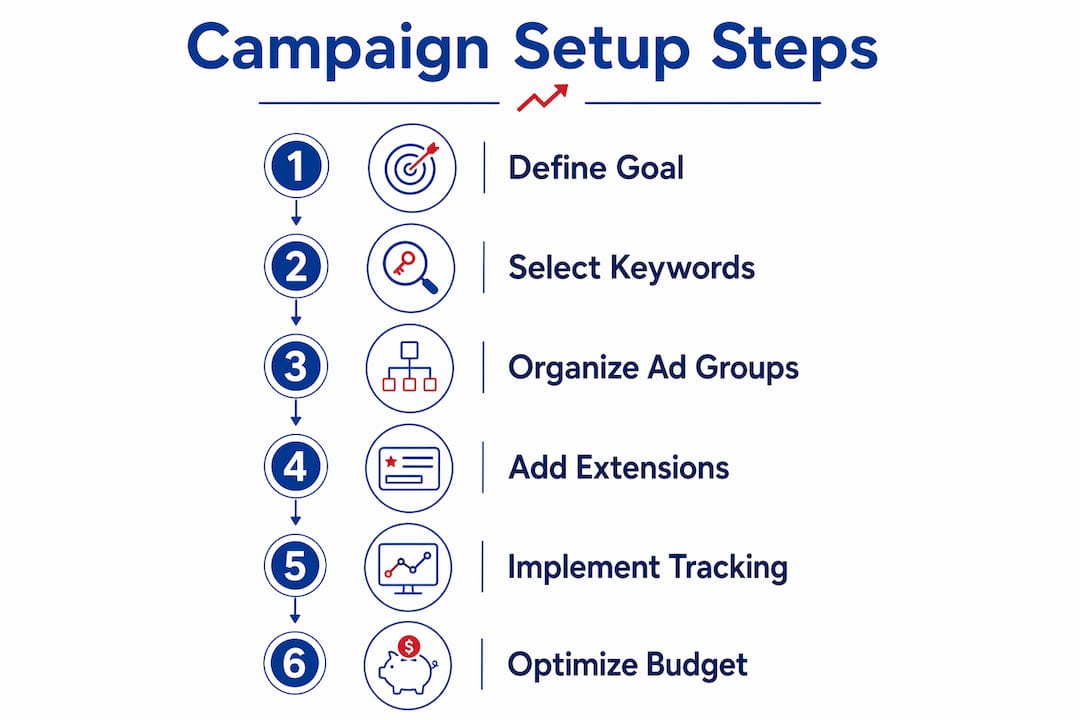
Poor campaign structure, not budget, is the most common reason service business campaigns fail. The fix is straightforward: separate your campaigns by commercial goal.

Recommended campaign structure:
| Campaign | Goal | Example keywords |
|---|---|---|
| Emergency/urgency | Immediate calls | “blocked drain Melbourne”, “emergency plumber Collingwood” |
| Standard bookings | Form leads + calls | “bathroom renovation Richmond”, “roof repair Hawthorn” |
| Brand | Protect brand searches | “[Your business name]” |
Within each campaign, create tightly themed ad groups. One ad group per service type keeps your ads relevant and your Quality Score high.
Match types: Use phrase match and exact match only to start. Broad match pulls in irrelevant searches and wastes budget fast, especially for tradies competing in a dense market like Melbourne.
Negative keywords to add from day one:
- jobs, careers, apprenticeship, training
- DIY, how to, free, cheap
- course, certificate, licence (when not relevant)
- YouTube, Reddit, forum
Pro Tip: Name your campaigns clearly: “[Service] | [Location] | [Goal]” — for example, “Plumbing | Melbourne CBD | Emergency Calls”. Clean naming makes reporting and agency handovers far simpler.
Add call extensions, location extensions, and sitelinks to every campaign. These lift click-through rates and signal relevance to Google’s auction, which improves your Quality Score and lowers your cost per click.
Conversion tracking, bidding, and realistic Australian budgets
You cannot optimise what you do not measure. The three conversions every service business must track are phone calls, form submissions, and booked jobs.
Set up these conversion actions first:
- Google call tracking via call extensions (tracks calls from the ad itself).
- Website call tracking using a forwarding number on your landing page.
- Form submission confirmation page as a conversion goal.
- Booking confirmation page if you use an online scheduler.
Call tracking is non-negotiable for most service businesses because the phone is still the primary conversion channel. Without it, you are flying blind.
Bidding strategy guidance:
Use manual CPC for the first 30–60 days while you collect data. Smart bidding strategies like Target CPA or Maximise Conversions need at least 30 conversion events to work reliably. Switching to smart bidding too early, before the algorithm has enough signal, often inflates costs. For more on smart-bidding caveats, check the 2025 guide.
Sample Melbourne budget ranges:
| Business size | Daily budget | Monthly spend | Expected early leads |
|---|---|---|---|
| Solo tradie / small service | $50–$100/day | $1,500–$3,000 | 10–40 leads |
| Growing service business | $50–$100/day | $1,500–$3,000 | 10–40 leads |
| Established multi-crew | $50–$100/day | $1,500–$3,000 | 10–40 leads |
A daily campaign budget of $50–$100 is commonly recommended for meaningful volume in metro areas such as Melbourne, Sydney, and Brisbane, based on current market guidance.
Campaigns need a minimum of 30–60 days of data before meaningful optimisation is possible. Avoid pausing or restructuring in the first two weeks.
What makes an ad and landing page actually convert?
Your ad and landing page must match the searcher’s intent exactly. If the ad says “Same-day plumber in Northcote,” the landing page headline must confirm that same promise.
Landing page checklist:
- Visible phone number above the fold, click-to-call on mobile
- Headline that mirrors the ad (service + suburb + urgency if relevant)
- Licence number and insurance details displayed clearly
- Google reviews or star rating visible without scrolling
- Job photos showing real work in Melbourne suburbs
- Page load time under 3 seconds
A well-matched landing page reduces bounce rate and improves Quality Score, which directly lowers your cost per click. For a full checklist, the Google Ads landing pages guide covers every element in detail.
Ad copy that works for Melbourne service businesses:
Licensed Electrician | Melbourne’s Inner North
Same-day bookings. Upfront pricing. No call-out surprises.
Call now for a free quote — available 7 days.
Lead with trust signals: licence, suburb, response time, and a single clear call to action. Generic headlines like “Best Plumber in Melbourne” do not stand out and do not earn clicks.
Ad extensions that lift performance:
- Call extensions (show your number directly in the ad)
- Location extensions (show your suburb or service area)
- Sitelinks (link to specific services: “Hot Water Systems”, “Blocked Drains”)
- Structured snippets (list service types or suburbs served)
Should you manage Google Ads yourself or hire an expert?
DIY makes sense if you have time to learn the platform, a modest budget to test with, and patience to wait 60 days for meaningful data. Hire a specialist when your time is worth more than the learning curve, or when a previous campaign burned money without results.
Questions to ask any agency or coach:
- Can you show case studies from Melbourne tradies or service businesses?
- What is your target cost per lead for my service category?
- How often do you report, and what does the report include?
- What is your onboarding process and timeline to first leads?
- Do you manage my account directly or outsource it?
Red flags to watch for:
- No trade-specific or service-business case studies
- Recommending broad match or Performance Max without clear controls
- Vague targets (“we’ll improve your results”) with no CPA or lead-volume benchmarks
- Locking you into a long contract before proving results
Australian agencies typically charge AUD $500–$1,500/month for Google Ads management, plus a setup fee. For a breakdown of what those fees include, the Google Ads management pricing guide is a useful reference before you evaluate proposals. If you want to assess coaches specifically, the best business coaches in Melbourne guide covers what to look for.
Your 30-day starter plan for a Melbourne service business
Complete this plan and you will have your first leads, a baseline cost per lead, and a real dataset to optimise from.
Week 1: Foundation
- Create your Google Ads account and link Google Analytics.
- Set up call tracking and form conversion goals.
- Build your first campaign: one service, one location, 10–15 tight keywords.
- Add your negative keyword list before the campaign goes live.
Week 2: Launch
- Go live with a $50–$100/day budget.
- Check search term reports every two days and add new negatives.
- Confirm call tracking is firing correctly.
Week 3: Creative review
- Check which ad variations are getting clicks.
- Pause ads with zero impressions after 7 days.
- Verify landing page load speed and click-to-call function on mobile.
Week 4: First optimisation
- Review cost per lead against your job value.
- Pause keywords with high spend and zero conversions.
- Decide whether to scale budget or refine targeting.
Starter keyword bucket (Melbourne plumber example):
| Keyword | Match type |
|---|---|
| “emergency plumber Melbourne” | Exact |
| “plumber Fitzroy” | Phrase |
| “blocked drain Richmond” | Exact |
| “hot water repairs Collingwood” | Phrase |
| “plumber near me” | Phrase |
Start with 10–15 tightly themed keywords, not a sprawling list. Quality beats quantity in the early learning phase.
Key takeaways
Google Ads for service businesses works best when you combine tight “service + suburb” keywords, phrase and exact match types, call tracking from day one, and a minimum 30-day data window before making major changes.
| Point | Details |
|---|---|
| Use service + location keywords | Target phrases like “plumber Fitzroy” or “electrician Collingwood” for high-intent leads. |
| Phrase and exact match only | Avoid broad match until you have 60 days of data and a clear negative keyword list. |
| Track calls from day one | Set up Google call tracking and a forwarding number on your landing page before launch. |
| Wait 30–60 days to optimise | Campaigns need sufficient data before you pause keywords or change bidding strategies. |
| Mybusinessmarketingcoach | Offers Google Ads management, business coaching, and landing-page work for Melbourne service businesses. |
The honest truth about Google Ads for Melbourne service businesses
Most Melbourne service businesses that struggle with Google Ads share one problem: they set up a campaign once and expect it to run itself. The platform rewards active management, not passive spending.
The advice to “just use smart bidding” is often premature. Smart bidding needs conversion data to function well. A campaign with fewer than 30 conversions in 30 days is not ready for automated bidding, and forcing it there early tends to inflate costs rather than reduce them. Manual CPC with a tight keyword list and a solid negative keyword strategy will almost always outperform an under-trained smart bidding campaign in the first two months.
The other underrated factor is landing page alignment. Most owners focus entirely on the ad and ignore the page it sends traffic to. A well-written ad pointing to a generic homepage will lose to a mediocre ad pointing to a fast, specific, suburb-named landing page every time. The page is where the conversion happens, and it deserves as much attention as the campaign itself.
Mybusinessmarketingcoach: Google Ads and coaching for Melbourne service businesses
Running Google Ads well takes more than a live campaign. It takes the right structure, the right tracking, and someone who knows Melbourne’s service market.
Mybusinessmarketingcoach works with Melbourne service businesses on Google Ads management, business coaching, and landing-page work, all under one roof. Rather than paying a large agency that outsources your account, you get direct coaching and implementation from a team that understands local CPCs, tradie markets, and what actually converts in Melbourne suburbs. Whether you want a one-on-one coaching session to build your own campaign or a fully managed Google Ads service, the starting point is the same: a free 30-minute audit of your current setup or a clean-slate starter plan. Book your audit at Mybusinessmarketingcoach and get a clear picture of what your budget should deliver.
Authoritative references and further reading
- Google Local Services Ads overview — eligibility, verification, and the pay-per-lead model explained.
- Getting started with Local Services Ads — step-by-step setup and business verification requirements.
- Google Ads for Tradies — Australia — Australian-market guidance on campaign structure, match types, negative keywords, and budget ranges.
- How to set up Google Ads for tradies — practical setup walkthrough for trade service businesses.
- Google Ads for tradesmen: a comprehensive guide — keyword research, landing-page optimisation, and conversion tracking for service providers.