
A strong client onboarding process is the difference between a client who stays and one who quietly disappears within 90 days. At its core, onboarding is a structured, multi-phase workflow that turns a signed contract into a productive working relationship built on trust, clarity, and aligned expectations. It is not just paperwork. It is the first real experience your client has of how you operate.
The human-to-human handoff matters more than most business owners realise. Clients are not just checking boxes. They are confirming they made the right decision hiring you. Every interaction in those first weeks either reinforces or erodes that confidence.
Here is what an effective onboarding process covers:
- A clear welcome within hours of contract signing
- Defined ownership so nothing falls through the cracks
- A structured intake process before any work begins
- A kickoff meeting that sets communication expectations
- A scheduled 30-day review built in from day one
Pro Tip: Send your welcome email within the first hour of contract signature. That window, often called the “golden hour,” is when client excitement is highest and first impressions are set. A prompt, warm message signals professionalism before a single deliverable is produced.
Table of Contents
- What does a professional client onboarding process look like?
- How do you measure whether your onboarding is working?
- How do you set clear onboarding goals and success metrics?
- Your client onboarding checklist
- Mybusinessmarketingcoach helps you build onboarding that retains clients
- Key takeaways
What does a professional client onboarding process look like?
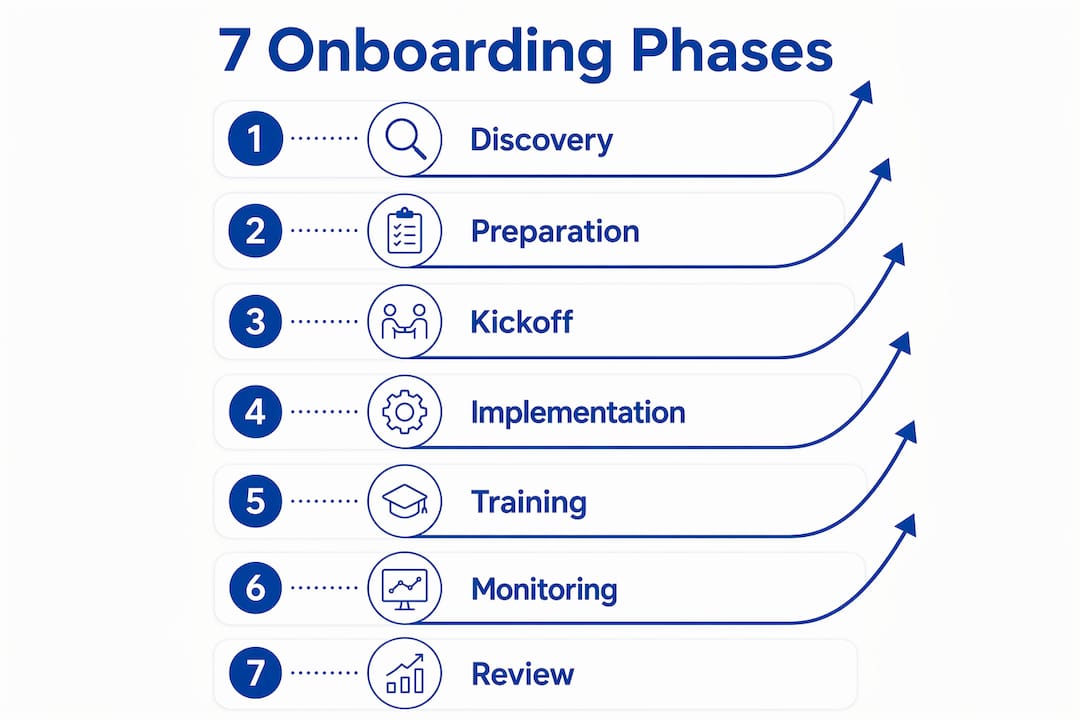
A professional client onboarding process consists of seven sequential phases starting with pre-onboarding preparation and ending with a handoff and 30-day review.
- Pre-onboarding preparation. Before the client ever logs in, your team documents scope, confirms pricing, and captures anything raised during the sales conversation. Internal setup always precedes client welcome.
- Contract and payment finalisation. Lock in the signed agreement and confirm payment before scheduling anything else. Rushing past this stage creates billing disputes later.
- Welcome and portal access. Set up the client workspace first, then invite the client in. Use a single portal that combines e-signature, file collection, payment, and communication in one place to avoid fragmentation across email threads and shared drives.
- Discovery and intake. Send a structured intake form. A well-designed form taking 10–15 minutes and surfacing alignment risks early reduces misunderstandings before work begins. Intake always precedes document collection.
- Document and asset collection. Request only what is needed for the current stage. Asking for everything at once overwhelms clients and slows responses.
- Kickoff meeting. This is where the signed agreement becomes a working relationship. Cover goals, deliverables, communication cadence, and the first milestone. Kickoff calls are pivotal for trust and must set clear expectations to avoid misunderstandings later.
- Handoff and 30-day review. Brief your team, assign task ownership, and schedule the 30-day check-in before the kickoff call ends. A 15-minute kickoff call should always conclude with scheduling the 30-day check-in to prevent gaps leading to client churn.
Assigning clear ownership at every phase prevents duplication and missed tasks during the transition from sales to delivery. Without a named owner, the “second win” between contract signature and first deliverable is easily lost.
Pro Tip: Automate reminders and document requests for admin efficiency, but keep personal interactions like welcome messages and kickoff calls manual. Automation handles the logistics; human touchpoints build the trust.
How do you measure whether your onboarding is working?
Poor onboarding correlates with significant client loss within the first 90 days, while top-performing service firms complete onboarding very quickly, often within a few days. Those two facts tell you exactly what to measure and how fast to move.
Practical measurement approaches include:
- Client retention rate at 90 days. Track how many new clients remain active after the first three months.
- Onboarding completion speed. Measure days from contract signing to project kickoff.
- Client satisfaction surveys. Send a short survey immediately after onboarding concludes, not months later.
- Milestone tracking. Log whether each phase was completed on time and by whom.
- Churn analysis. When a client leaves early, identify which onboarding phase broke down.
Clients lose confidence within the first 30 days when onboarding is poor. Structured check-ins during this window reduce churn significantly. The 30-day review is not optional. It is the mechanism that catches misaligned expectations before they become cancellations.
Onboarding is human-centred. Metrics tell you where the process broke down, but the fix usually involves a conversation, not a new template.

How do you set clear onboarding goals and success metrics?
Vague goals produce vague results. Before the kickoff meeting, define what success looks like for this specific client, in measurable terms. “Get the client live” is not a goal. “Complete website build and launch by Week 6 with client sign-off on all pages” is.
Align your internal team and the client on the same metrics from day one. Document them in the project workspace so there is no ambiguity later. Goals should cover the outcome the client hired you to achieve, the timeline, and the communication frequency expected along the way. When everyone is working from the same definition of success, scope disputes drop and client confidence rises. Building community trust through content and clear communication from the outset reinforces this alignment throughout the engagement.
Your client onboarding checklist
Use this checklist every time you onboard a new client. Adapt it to your service, but keep the sequence.
- [ ] Contract signed and initial payment confirmed
- [ ] Sales-to-team handoff completed with goals, scope, and key contacts documented
- [ ] Client profile and project workspace created
- [ ] Welcome email sent within one hour of contract signature
- [ ] Intake form sent and responses reviewed before document requests
- [ ] Required files, assets, and account access collected
- [ ] Kickoff meeting scheduled and conducted
- [ ] Goals, success metrics, and communication rules confirmed in writing
- [ ] Project timeline with milestones shared with the client
- [ ] 30-day review meeting scheduled at kickoff
- [ ] Post-onboarding feedback survey sent
- [ ] Onboarding completion confirmed before moving to active delivery
For service business owners running multiple client engagements, a consistent checklist like this prevents the costly habit of rebuilding your process from scratch with every new client.
Mybusinessmarketingcoach helps you build onboarding that retains clients
Most Melbourne business owners have the skills to deliver great work. What they often lack is a structured system to bring clients in properly, so the relationship starts strong and stays that way.
Mybusinessmarketingcoach works with service providers and business owners to build onboarding workflows, communication templates, and client retention strategies that actually hold up under pressure. The coaching is practical, one-on-one, and grounded in what works for Australian businesses, not generic frameworks from overseas. Whether you need help designing your first onboarding flow or tightening a process that keeps losing clients at the 60-day mark, business coaching in Melbourne gives you a clear path forward. Book a session with Mybusinessmarketingcoach and walk away with a process you can use immediately.
Key takeaways
A structured client onboarding process, with defined phases, clear ownership, and a scheduled 30-day review, is the single most effective way to reduce early client churn and build lasting working relationships.
| Point | Details |
|---|---|
| Speed matters | Top-performing service firms complete onboarding within five days; poor onboarding is linked with up to 35% client loss within 90 days. |
| Sequence is non-negotiable | Internal setup must precede client welcome, and intake must precede document collection to avoid confusion and delays. |
| Ownership prevents gaps | Assigning a named owner to each onboarding phase stops tasks from falling between sales and delivery teams. |
| The 30-day review is critical | Schedule the follow-up check-in at the kickoff call itself; clients who go without structured contact in the first 30 days are at highest risk of churning. |
| Mybusinessmarketingcoach | Offers one-on-one marketing coaching to help Melbourne business owners design and implement onboarding workflows that improve retention and client satisfaction. |